
They all know the secret to a long life
What do a 400-year-old shark, an ancient Greek, and a village in Japan have in common?

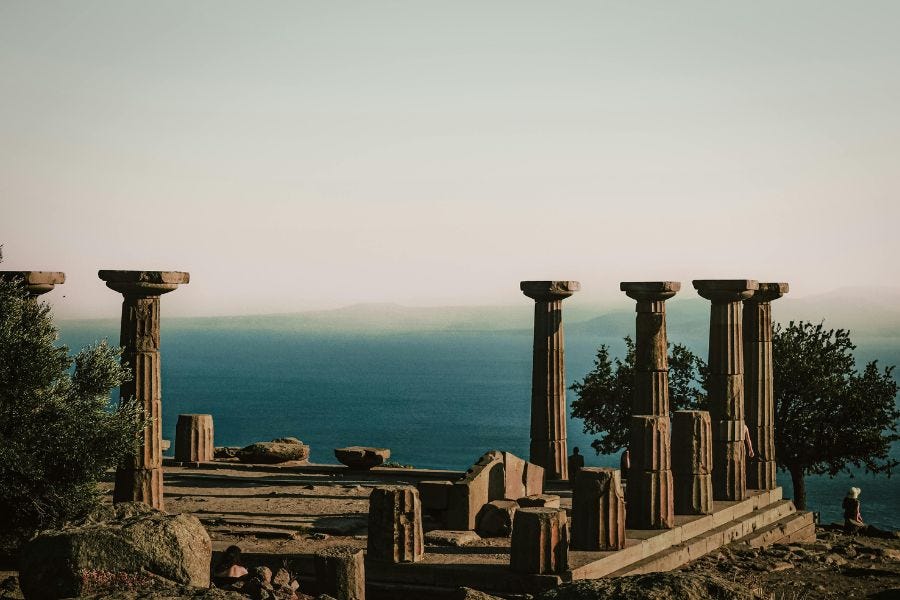
On the bus ride to Sweden a few days ago, I finally had time to continue reading Nicklas Brendborg’s book “Jellyfish Age Backwards.” Outside, the Scandinavian landscape passed by while I immersed myself in the fascinating world of longevity. I couldn’t help but think of Aristotle—the Greek philosopher who dealt with the aging of animals and humans over 2000 years ago in his work “De longitudine et brevitate vitae” (On the Length and Shortness of Life). This connection between ancient knowledge and modern science fascinated me. Brendborg also mentions in his book the Blue Zones, those special regions of the world with high longevity, which I already wrote about in my article The Secret to a Long Life.
And so the thought came to me: What can we learn from 2000 years of longevity research? What connects Aristotle’s observations with the latest scientific findings?
Aristotle and the Beginnings of Aging Research
Aristotle was not only a philosopher but also a meticulous observer of nature. On the Greek island of Lesbos, he studied the lives of animals and plants and discovered that different species live for different lengths of time. He noticed in his observations that larger animals tend to live longer than smaller ones—an observation that still holds true in many cases today. Elephants live longer than mice, whales longer than dolphins.
What particularly fascinated Aristotle, however, was the question of why. Why do some organisms age faster than others? His theory was based on the idea of “vital heat”—a kind of life energy that gets used up over time. The slower this heat is consumed, the longer the life. A poetic notion, but one that is not scientifically valid.
From Antiquity to Modern Science
Nicklas Brendborg picks up precisely this thread in his book and shows how our understanding of aging has evolved. Today we know that aging is a complex biological process controlled by genes, proteins, and environmental factors. Modern research has discovered that certain proteins can slow down or accelerate aging. Animals like the famous jellyfish Turritopsis dohrnii can even age biologically “backwards”—a phenomenon that would have left Aristotle speechless.
Yet despite all scientific progress, some of Aristotle’s fundamental observations remain surprisingly current. His insight that lifestyle and environment influence longevity is found today in epigenetics. Epigenetics describes how environmental factors and our lifestyle can switch genes on or off. Thus genes are not everything—our environment and our way of life largely determine how long and how healthy we live.
Lessons from the Animal Kingdom
What can we learn from the animal kingdom about a long life? Brendborg presents fascinating examples: Greenland sharks that can live over 400 years. Naked mole rats that seem resistant to cancer. Turtles whose aging process is so slow it’s barely measurable. All these animals have developed strategies to cheat aging.
A central mechanism is autophagy—a cellular self-cleaning process in which damaged cell components are broken down and recycled. This process is activated by caloric restriction, a principle also practiced in the Blue Zones. In Okinawa, Japan, for example, people eat according to the “80 percent rule”—they stop eating when they are 80 percent full. This practice could explain why so many people there age healthily.
Tip: Try the “80 percent rule” at your next meal too. Or intermittent fasting such as a 16-hour eating break can also support this self-healing process of the cells.
The Blue Zones: Where Theory Meets Practice
The connection between biological insights from the animal world and the Blue Zones is fascinating. In these regions—Okinawa (Japan), Sardinia (Italy), Costa Rica, Ikaria (Greece), and Loma Linda (USA)—people not only live longer but also healthier. They move naturally and regularly, eat a plant-based diet, maintain strong social bonds, and have a clear life purpose, their ikigai. In these regions, life expectancy is about 10 years higher than worldwide and sometimes even more—particularly in the proportion of those who live to be 90 to 100 years old.
What particularly appeals to me as an athletically active person and nature lover: Movement in the Blue Zones is not a burdensome duty, no rigid fitness program. It is part of daily life—gardening, walking a lot, keeping the house in order. This natural form of activity corresponds much more to our evolutionary heritage than sitting in an office for hours, interrupted by intense gym sessions.
The Role of Environment and Community
Another fascinating aspect that both Brendborg and Blue Zones research emphasize: Genes play a surprisingly small role in our longevity. Studies on twins show that only about 20 percent of a person’s average life expectancy is determined by genes. The remaining 80 percent depends on lifestyle and environment. People from Blue Zones who move away lose their exceptional longevity—clear proof that it’s not about genes.
What makes these regions so special? They are often geographically isolated—as islands, peninsulas, or mountain regions. This isolation leads to strong social cohesion. People know each other, support one another, have deep connections to the community. As someone who has moved from the city to the countryside myself, I can only confirm this observation. The peace, the absence of (too many) stimuli, the connection to nature, the feeling of being part of a community—all of this contributes to a deeper sense of well-being.
An aspect that is often underestimated: Your partner has an enormous influence on our longevity. People in relationships often adopt similar habits—in sports, nutrition, stress management. This social effect is amplified in the Blue Zones, where entire communities share healthy lifestyles. It’s not just individual self-discipline that counts, but also the people with whom we share our lives.
What Does This Mean for Us Modern People?
The insights from 2000 years of aging research—from Aristotle to Brendborg—boil down to simple but powerful principles. A long, healthy life doesn’t require expensive anti-aging treatments or miracle pills. Rather, it requires a return to what makes us human: movement in nature, genuine social connections, a plant-based diet, stress reduction, and a clear life purpose.
For me as a windsurfer and outdoor enthusiast, this message is particularly powerful. Time on the water, physical exertion, connection to the ocean—all of these are not lifestyle extras but fundamental building blocks for a long, fulfilled life. The sustainability I practice in dealing with nature is also reflected in the sustainability of my own body.
What has fascinated me so much: The continuity of human curiosity. Aristotle asked the same questions 2000 years ago that occupy us today. Why do we age? How can we live longer? His answers were wrong, but his method—precise observation of nature—was right. Today we combine this power of observation with cutting-edge genetics, molecular biology, and epidemiology.
But the essence remains the same: A long life is not a coincidence but the result of conscious decisions. Decisions we make daily—in eating, in movement, in our relationships, in our connection to nature.
An Invitation to Conscious Living
Perhaps the greatest gift of longevity research is not the prospect of a few additional years, but the reminder of how we should live now. If the principles for a long life—movement, community, connection to nature, healthy eating—are the same as the principles for a happy life, then longevity is not a distant goal but a natural consequence of a well-lived life.
“The NOW is all you have..” - Eckhart Tolle
For me, this means: spending more time on the water, sharing more meals with friends and my family, enjoying more moments in nature. Not as a means to the end of longevity, but because these things make life worth living now. Aristotle might have called this “a good life”—”eudaimonia.” We might speak today of quality of life. In the end, it comes down to the same thing.
Sometimes it takes these slow moments—a bus ride, a long walk, a meditative surf session—to ask the really important questions. About my own life and how I want to shape it. Longevity is no longer a secret. It’s a choice you make daily. On the water. When eating. In your relationships. What do you choose today?
Take Care,
Tobias
Ocean Photography - “Photo of the Week”
ORIGINAL OCEAN-PHOTOGRAPHY BY TOBIAS BRUNS
Edition: Portugal, Algarve

Bring the serene vibes of a sandy beach, blue ocean, and crashing waves into your space with these vibrant posters. Perfect for beach lovers and those looking to add a touch of relaxation to their home decor. Ideal for coastal-themed homes, summer decor, beach parties, and ocean-themed celebrations.
Each print is designed with great attention to detail to bring the relaxing ocean atmosphere into your home - inspired by the ocean & surfing culture!
