
Wave Windsurfing: A Beginner's Guide
Your Guide to the Perfect Start in Wave Windsurfing

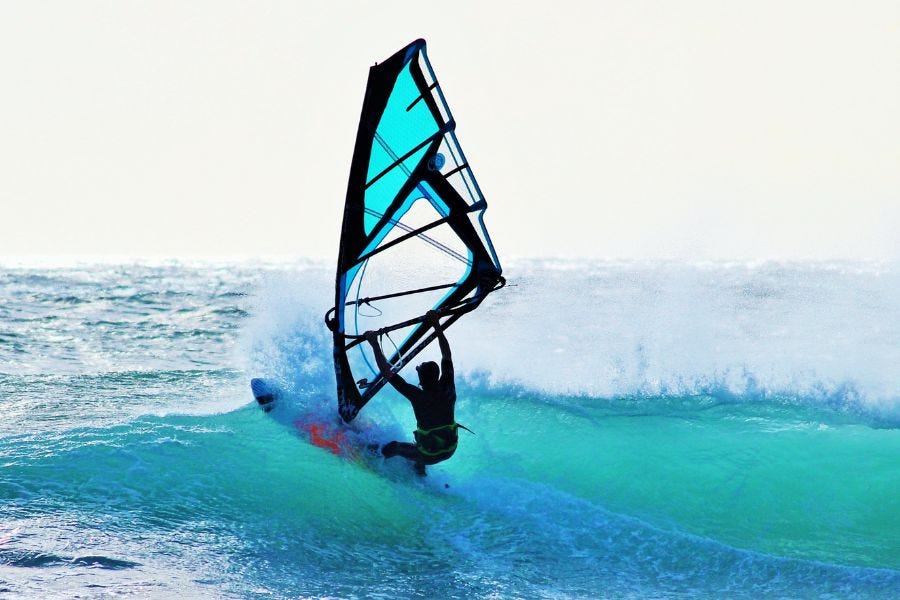
The most important insight upfront: "For big waves, you primarily need courage," as former German wave legend Robby Seeger says. But before you throw yourself into the monster waves of Jaws in Hawaii, let's start with the basics in the smaller waves of the Baltic or North Sea. The transition from flat-water windsurfing to wave riding is an exciting step – and absolutely doable with the right preparation.
What You Should Know
Wave riding with a windsurf board is the ultimate discipline of the sport. It combines the pure power of wind with the raw energy of the ocean - a unique experience that becomes addictive - in a positive way, of course ;)
The Basics for Your Start
Basic Riding Requirements:
Confident mastery of basics (water start, power jibe)
Good overall physical fitness
Swimming abilities and high endurance
Equipment:
Smaller wave-capable board - choose slightly larger at first
Preferably a thruster (three fins) or quad-fin (four fins) set
Wave-suitable sail - usually in the range of 3.7 to 5.4 square meters
💡 Tip: Choose no more than about 15 liters of excess volume (body weight + 15 liters) to ensure you'll enjoy your board for a long time.
💡 Tip for wave beginners and onshore conditions: Position fins more towards the back, this gives the board more grip and reduces spinouts.
A Deeper Look
As Robby Naish, one of the most influential windsurfers of all time, has demonstrated: "The body's center of gravity must always stay above the board." This fundamental technique is the key to success. The Baltic Sea offers perfect conditions for your first aerial and wave riding attempts.
The Most Important Steps for Getting Started:
Choose Location: Start at a spot with manageable waves and sandy ground. Reefs can come later.
Timing is Everything: As with many things in life: "Timing is everything" - this especially applies to choosing the right moment to enter the water or approach a wave.
Progressive Learning Approach: Start with small waves and gradually increase. Even big-wave surfers like Kai Lenny or Sebastian Steudtner started small.
💡 Tip: Spend your first sessions observing the waves and understanding their movement patterns. Being able to read the ocean is fundamental.
Tips for Starting
It's normal for beginners to have difficulties in the shorebreak. Everyone was at this point once - even the pros. With more experience, starting through the surf becomes increasingly easier.
Before starting, look out over the ocean and try to spot a wave set. The goal is to start when the last wave of the set breaks.
Always keep your equipment high and away from white water.
At first, use your most practiced carrying method - this is not the time to experiment.
Learn to push your equipment through the water - at a 90° angle to the wave if possible - while walking out, maybe even jumping on and starting.
Practice quick beach starts on small wave days.
Tips for Landing
Returning to the beach is usually simple, but pay attention to wave sets. The best time to land is, just like when starting, right after a wave set.
Sail high and behind a wave to have as much water as possible under your board and to be able to sail as far as possible to the beach.
Don't sail in front of the wave directly towards the beach
Unhook from the harness early and get out of the footstraps early, with weight forward.
Always keep an eye on the waves behind you.
Common Mistakes & Safety is Everything
Windsurfing in waves is extremely exhausting, as I know from personal experience. That's why good physical and mental condition is absolutely crucial. It makes no sense to go into the waves exhausted. You should definitely listen to your body – a lesson I had to learn the hard way.
Starting too early in waves that are too big
Underestimating currents and wind conditions
Incorrect sail trim or mast base positioning
Overestimating your own abilities and fitness conditions
Never surf alone
Know and respect local spot rules
Essential: Check weather and wind conditions beforehand
The Big Trend
Wave riding in windsurfing is currently experiencing a renaissance. "Big wave surfing perfectly captures the zeitgeist right now," as Robby Seeger noted in an interview with Surf Magazine last year. This also means: There are more resources and a larger windsurf wave community than ever before.
🌊 A special tip for Baltic Sea riders: You can practice radical maneuvers like aerials even in smaller waves. The perfect training for bigger challenges!
Additional Useful Sources
Here you'll find more information and links for learning wave windsurfing:
Book: Windsurfing Trickionary 3. Available here!
Surf Magazine Article: The best tips for windsurfing in the waves:
What's the best foot strap setting for wave windsurfing? Short tutorial video clip from windsurf pro Ben Proffitt on Windsurfing TV:
Ocean Photography - “Photo of the Week”
ORIGINAL OCEAN-PHOTOGRAPHY BY TOBIAS BRUNS
Edition: Portugal, Algarve

Capture the serene atmosphere of the ocean on the west coast of Portugal with these vibrant posters featuring aerial views of waves. Perfect for ocean lovers and beach enthusiasts, these posters will bring a calming and peaceful vibe to any room.
Each print is designed with great attention to detail to bring the relaxing ocean atmosphere into your home - inspired by the ocean & surfing culture!
Take care!
Tobias
Follow me on Pinterest for more ocean & surfing content!
